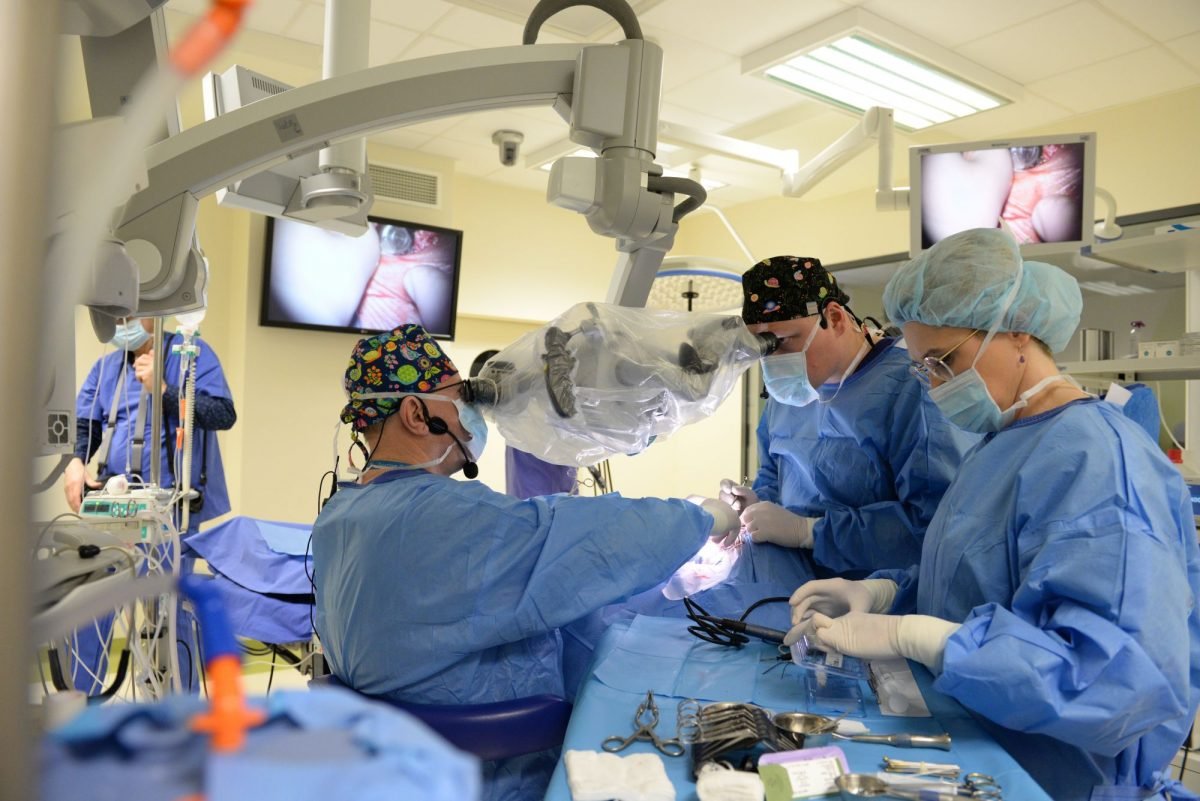
Poland’s first implantation of the pioneering active bone-conduction implant BONEBRIDGE BCI 602 took place at the World Hearing Center in Kajetany. Prof. Henryk Skarżyński performed the operation on 27 February 2020 with a team including Prof. Piotr H. Skarżyński. It marked a new stage in treating various hearing defects involving the external and middle ear. The new implant can improve hearing in many cases, including patients whose previous ear operations were unsuccessful.
The greatest advantage of the BCI 602 BONEBRIDGE is its size. Unlike its predecessor, the BCI 601, it can serve a broader group of patients for whom anatomical factors — excessively thin bone, a small mastoid process or other congenital deformities — previously prevented implantation.
‘The implant placed in Kajetany is a major step forward in treating hearing loss. It provides excellent hearing quality, like the previous model, but its smaller size means we can also implant it in children,’ says Prof. Piotr H. Skarżyński, a member of the surgical team.
The BONEBRIDGE BCI 602 uses bone conduction, transmitting sound through the skull directly to the cochlea. It has two components: an external speech processor and an internal part completely beneath the patient’s skin. The system is effective for people with permanent hearing loss following various external or middle ear operations, developmental defects of the external and/or middle ear, and congenital microtia and/or external auditory canal atresia. It is also an option for single-sided deafness.
The youngest patients form a particular group, for whom the new implant offers the chance of normal hearing and speech development.
BCI 602 BONEBRIDGE offers several benefits. These include MRI scanning at 1.5 tesla without another operation and intact skin without irritation. Placing the implant entirely under the skin therefore has an important medical benefit as well as a cosmetic one. Implants that do not penetrate the skin have very low postoperative complication rates and do not block the external auditory canal.
Implantation does not require further surgical interventions because all replaceable system components are in the external sound microprocessor. Placing the vibrating transducer entirely under the skin also allows considerable freedom of use. Since the power supply and electronics are external, they can be replaced with newer versions even after many years. The system can continue to improve without surgery.
The speech processor can be connected and the system activated just a few weeks after surgery. Operating parameters are set by computer using audiological assessment results and the user’s individual needs. The processor’s advanced digital technology enables fitting to optimise speech understanding and provide the most natural sound possible in different acoustic situations. Its small size and range of colours make it extremely discreet.
Source: https://csim.pl/nowa-era-w-leczeniu-wrodzonych-wad-sluchu/